Advanced SSE models
The worked example shows why Guane withholds model weights.
The bundled example is synthetic. Its values are invented and its branch lengths are arbitrary. Results are a demonstration, not biological evidence.
Before you start
Load the example in the SSE models Data card and click Use matched taxa. Resolve the mismatch shows each step. Each SSE card groups its controls in collapsible sections, such as Model and data settings (open) and Advanced fitting controls.
Sampling and root
Sampling fraction for state 0
The share of living species in state 0 that your tree includes. Sampling fraction for state 1 does the same for state 1.
- Where
- BiSSE Model and data settings
- Default
- 1 for each state
- Change it when
- Species in one state are better sampled than in the other. Unequal sampling can mimic state-dependent diversification.
- Check after
-
The model line in Results shows
sampling.f.
Root treatment
Sets how the root state is weighted in the likelihood.
- Where
- BiSSE Model and data settings Root treatment
- Default
- Observed (ROOT.OBS)
- Change it when
- You have a justified root prior. Given (ROOT.GIVEN) opens Root probability for state 0.
- Check after
-
The model line in Results shows
root. Every candidate in the run uses the same root treatment.
Constraints and search
BiSSE parameter table (CSV)
Ties, fixes and bounds each rate for a Custom model.
- Where
- BiSSE Advanced fitting controls BiSSE parameter table (CSV)
- Default
- Empty. Click Fill parameter table for a template, and tick Custom under Models.
- Change it when
-
You want a hypothesis the presets do not cover, such as equal extinction with state-specific speciation. Rates with the same
Groupare tied. See the parameter table format. - Check after
- The Effective parameter constraints table in Diagnostics. Incompatible ties stop with “Tied BiSSE rates have incompatible fixed values or bounds.”
Optimizer starts
Sets how many deterministic starting points each model gets.
- Where
- BiSSE Advanced fitting controls
- Default
- 3 (range 1–8)
- Change it when
- Starts disagree. Guane needs at least two starts to show weights.
- Check after
-
The
StartSpreadcolumn, and “BiSSE starts disagree or an unconverged attempt is better. Refit before interpreting model support.”
Verify with an independent optimizer
Refits each model with a second optimizer from its best point.
- Where
- BiSSE Advanced fitting controls
- Default
- On
- Change it when
- Leave it on. Without verification, Guane does not show weights.
- Check after
-
The
Verifiedcolumn, and “Independent optimizer verification failed or disagreed. Weights and intervals are withheld.”
QuaSSE numerics
Measurement-error column
Uses a column of per-species standard errors for the continuous trait.
- Where
- QuaSSE Model and data settings Measurement-error column
- Default
- Common standard error, which uses Common measurement standard error (1)
- Change it when
- You have measured standard errors, in trait units. Zero and missing errors are not supported.
- Check after
- “The tip grid is coarser than a measurement standard error. Increase resolution; model weights are withheld.”
Trait grid bins
Sets the resolution of the trait grid that QuaSSE integrates over.
- Where
- QuaSSE Numerical integration controls Trait grid bins
- Default
- 1024
- Change it when
- The tip grid is coarser than the measurement error, or the likelihood is unstable.
- Check after
- “Every fit is checked with twice the grid bins and half the time step. Unstable likelihoods suppress model weights.”
Worked recipe
Worked example: a custom BiSSE with tied rates
Start in the BiSSE card, with the example matched in the Data card.
- Set Binary trait to
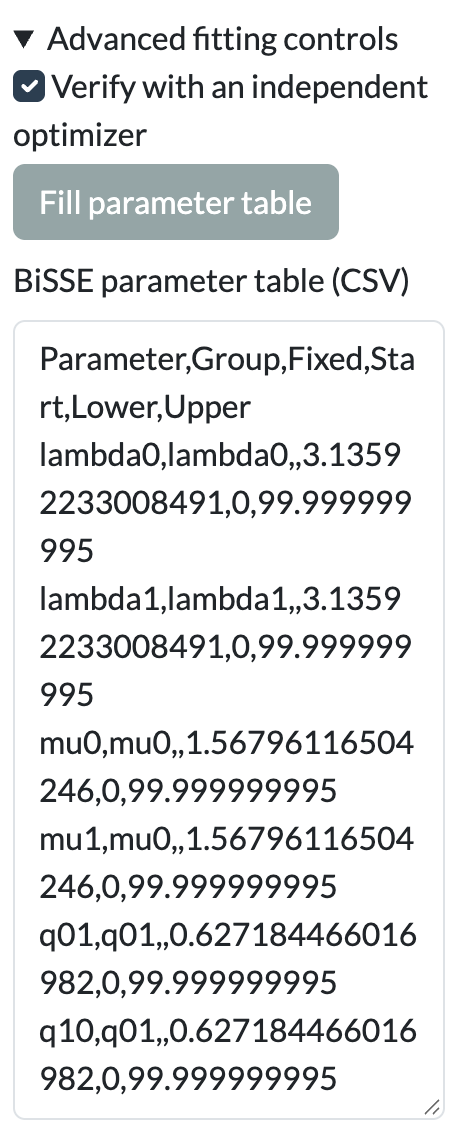
habitat_binary. Observed value coded as state 0 defaults toaquatic. - Open Advanced fitting controls and click Fill parameter table.
- In BiSSE parameter table (CSV), change the
Groupofmu1tomu0and theGroupofq10toq01. This ties extinction across states and makes transitions symmetric. - Under Models, tick Full, Trait-independent diversification and Custom.
- Set Sampling fraction for state 0 and Sampling fraction for state 1 to
0.8(invented values), and Optimizer starts to 5. - Click Run BiSSE. The status reads “BiSSE completed. Review convergence, bounds and model assumptions.”
- Open Diagnostics and check Effective parameter constraints: the Custom model shows the tied groups.
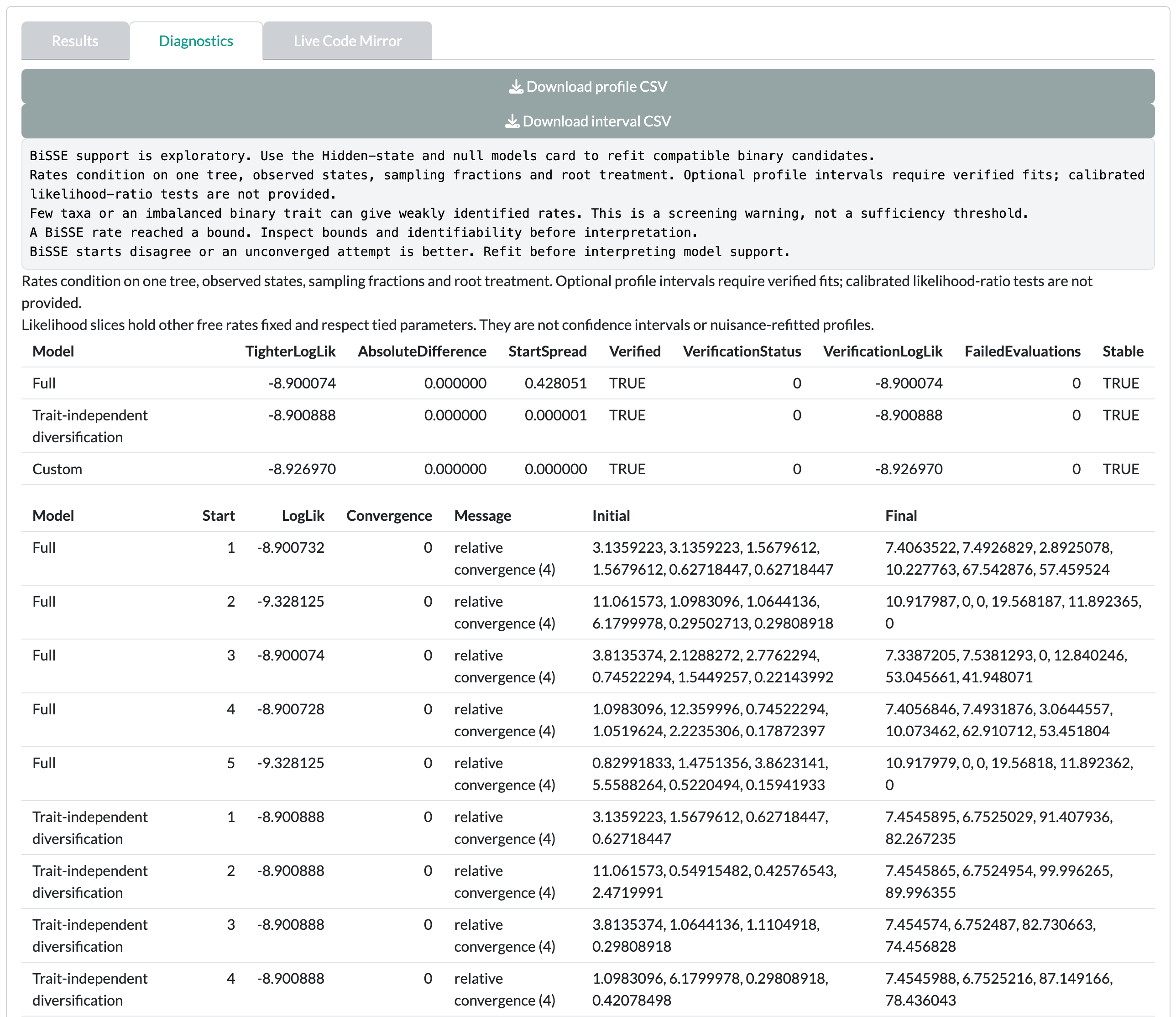
Expect the three models to reach log-likelihoods within a few hundredths of each other, with no weights: “BiSSE ranking weights are unavailable. Inspect individual fits and diagnostics.” Diagnostics warns “A BiSSE rate reached a bound. Inspect bounds and identifiability before interpretation.” and that starts disagree for the Full model. A 19-tip tree cannot separate these models. Its transition rates run to their upper bound, the same pattern as in Advanced ancestral states. If you try Run profile uncertainty on the Full model, Guane refuses: “Resolve fit diagnostics before calculating profile intervals.”
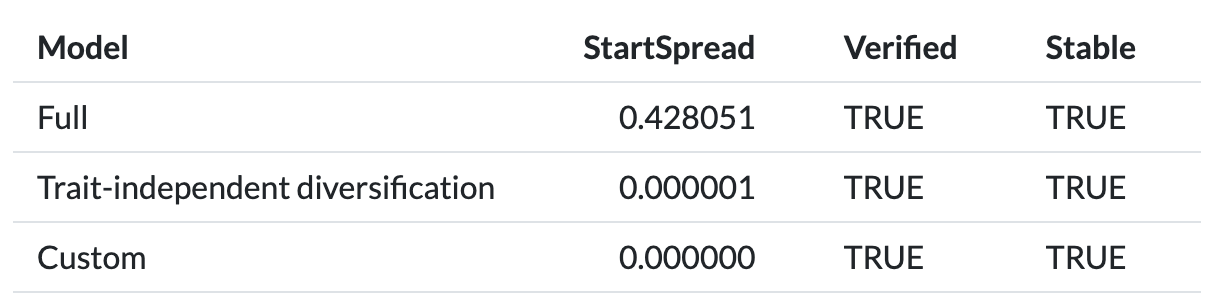
In the verification table, the Full model’s StartSpread is well above zero, while Verified and Stable are TRUE for all three models. Start disagreement alone is enough to withhold the weights.
When weights are withheld
Guane shows model weights only when every candidate in the run passes all of these checks:
- At least two models are selected under Models.
- It converged, and all of its starts converged.
- Its likelihood is stable under tighter integration tolerance.
- The independent optimizer verified it.
- No rate sits at a bound.
- Its starts agree, and there were at least two starts.
- No other candidate found a better feasible point for it.
- No two candidates have identical constraints.
If any check fails, the weights column stays empty. The failing check is named in Diagnostics.
Before you interpret
- A BiSSE preference for trait-dependent rates can come from rate differences unrelated to the trait. Refit in Hidden-state and null models and compare against CID-2 and CID-4.
- Missing weights mean the models could not be ranked. Do not compute them yourself.
- Sampling fractions and measurement errors are assumptions you supply. Report them.
Read State-dependent speciation and extinction before you report.